Thứ Ba, 24 tháng 2, 2015

Nagarkot, Nepal - Cradled in the Mountains

The ornate pines that stand guard en-route the journey from Bhaktapur, seemingly whisper  about the beautiful hills that approaches you !

Nagarkot, lying barely 32 Kms. away from Kathmandu, is a different world in itself. With ascent from Bhaktapur, the weather changes dramatically. The clean but cool air flowing across the mountains can blow your fatigue away and can catch you by surprise ! ( Indeed a welcome and pleasant surprise.) 

Newari Architecture
Architecture at the Nagarkot
The beautiful valley filled with dense pine trees paves way from the dust bowl that would be encountered on account of an ongoing road construction. Swiftly, the air keeps on getting pleasant with real freshness. Nagarkot, that is regarded as a 'Hill Station' (terminology common to the subcontinent and to an extent,  the Anglicized world) stands nestled and cradled among the Himalayas.

While the morning trip from Kathmandu to Bhaktapur is a pleasant surprise in terms of beating the city traffic, the trip to Bhaktapur, in true sense is a respite from the weather in Bhaktapur.
Lush Green Pine Valleys

The Kathmandu Valley below is associated with unique history and architecture however, Nagarkot is more about stunning landscapes and guess what, even better sunrises and sunsets!

It is common for visitors to come to Nagarkot for sunrises and even sunsets, but trust me even the scenery and landscapes on offer across the day can take your heart away!

The astounding resilience and determination witnessed across Nepal was rightfully captured in the poster below which as seen at Nagarkot.
Nepal, Determination and Resilience
Nepal : Story of Resilience and Determination
The beauty of Nagarkot grows on you, so much so, that to an extent, the beauty itself becomes a monotony. A monotony that you'd wish to get more monotonous than ever. The undeterred flags of faith splurge colours while they stand guard to un-wavered conviction in ever-wavering winds.

Unwavering flags waving in the crystal clean air
Smiling sunshine sit atop the densely populated pine trees and mingle with clear flowing breeze around. And the biggest bonus is that all of it comes with exquisite views.

Lush green Forests criss-crossing the sunshine and the wind


The prayer flags apparently spray colors in the air as the wind progresses under the spotless blue skies, almost persuading the clouds to clear up the mountains !


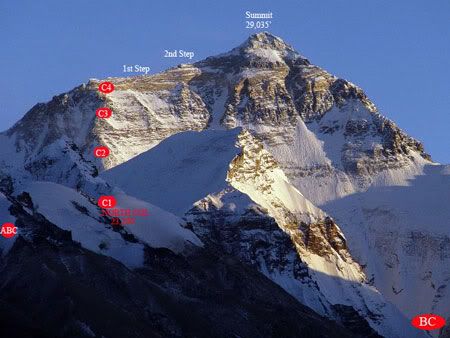
Eventually, I had the opportunity to view the Langtang valley as the mountains cleared up for the views ! And as the luck got better, couldn't believe that Mount Everest (locally known as Sagarmatha) lay ahead for the views, sneaking through the white clouds.

That feeling of witnessing the Everest is simply inexplicable ! Way more than Amazing, a truly lifetime experience !


Tips for the Place :
  • Nagarkot is definitely more than worth a day trip, best to reach during evening stay overnight and then decide as per your schedule.
  • At times, you need to be patient for the views of the Himalayas, including Mt. Everest.
  • Even you are moving from Kathmandu Valley, the chill in air at times can be a big surprise.
  • Needless to say, Nagarkot has access to excellent sunrises and to an extent sunsets as well.
  • Definitely do go to the Nagarkot 'Tower', known locally as 'Tower'. The views up there are really amazing.
  • I'd suggest Club Himalayas for food and stay as I had been to the place and found the services to be quite good, but then it is on the higher side of the economics !

Chủ Nhật, 22 tháng 2, 2015

Adventure World Magazine Launches New Website


Adventure World Magazine has launched a revamped website, offering up an easier to navigate, and read format, and expanding their coverage of adventure activities from around the globe.

Adventure World has been a top resource on the web for outdoor endurance athletes and adventure racers for some time. They always have top notch updates on major adventure sport races, such as the Abu Dhabi Adventure Challenge, Costa Rica's Coast To Coast Challenge, or even the Iditarod. They've even partnered with Sleep Monsters to get the latest race reports from events as they happen, further making them a hub of adventure racing news.

But beyond their coverage of adventure sports, there is a lot more great content in general. For instance, there is a nice feature story on the site right now that reminds us how we can make every day Earth Day, and the articles further down the page spotlight some on going expeditions, gear reviews, and other general adventure news.

Adventure World has also embraced this whole "social media" thing that is all the rage with the kids these days. There are icons on the front page which offer easy access to their RSS feed, Facebook Group, and Twitter feed as well. The end result, even more ways to find their great content, and get updates.

Drop on by and checkout the new site. Then bookmark the page, join the Facebook group, and tweet about how much you love all the changes. :)

Everest 2009: Insights on Rope Fixing


Alan Arnette is always a great source of information, and his Everest 2009 page is being updated daily with news from the mountain. Not only does he know many of the guides and climbers personally, Alan has also been on Everest three times, and has first hand knowledge of how things get done there, which is why today's update is so interesting.

Yesterday, I mentioned that a major logistical meeting went down on the mountain. This yearly pow-wow is where the teams hash out how the fixing of ropes is going to occur on the South Side of Everest. This meeting can be a bit frustrating for those involved, as not all the teams contribute the same level of supplies or manpower, with some trying to avoid helping as much as possible.

Alan offers up a great explanation of the process, saying that the Ice Doctors, who are payed out of the permit fees by the Nepal Ministry of Tourism's Sagarmatha Pollution Control Committee, take care of the route through the Khumbu Icefall and fixing the lines up to Camp 2. They won't go any higher than that however, which leaves the rest of the mountain, from the Lhotse Face to the summit, to be fixed by the teams.

From there on up, the teams work together in a loose union to fix lines all the way up the South Col to C4, where Alan says that the first team to make summit bid starts putting down the ropes. The climbers that follow use them too as they make their bids. He also makes a few points about climbers who go "solo and unassisted" and their use of the lines as well, saying that in this day and age, it is almost impossible to go "unassisted" on Everest.

Of course the situation is completely different on the North Side, where Russell Brice and his Himex team have taken care of the fixed lines for year. Brice would have his Sherpa teams, amongst the best in the world, fix the lines all the way up the mountain, and charge each climber $100 to use the lines. Most thought that was an excellent bargain, and were happy to comply. This year, Himex is on the South Side, and the China-Tibet Mountaineering Association is taking care of those duties.

An interesting read to be sure, and a nice look at the politics of the mountain.

Iditarod 2009: Makey On The Move!


You knew it was only a matter of time before two-time defending champ Lance Mackey made his move, and he did so yesterday afternoon, and as a result, he now has the lead in the 2009 Iditarod. Mackey is through the Shageluk checkpoint, meaning he's now covered more than 600 of the 1100 mile course.

Currently in second place on the leaderboard is Sebastian Schnuelle, winner of this year's Yukon Quest. He's also into Shageluk, but is roughly four hours behind Lance, and as of this writing he hasn't left in pursuit yet. Aaron Burmeister is running in third at the moment, with a number of mushers on the trail behind him hoping to make up ground.

Mackey seems to be putting the hammer down and hoping to put some distance between him and the competition, but with Nome not quite in sight yet, the rest strategy may still come into play. Especially considering the conditions out on the trail are said to be demanding. At the moment, Lance is breaking trail for those that follow, and that's much harder on his dogs. It remains to be seen if he can keep up the pace and claim a third straight Iditarod. I wouldn't bet against him though.

Thứ Sáu, 20 tháng 2, 2015

Update on the Chocolate Sherpa Project


A couple of months back I posted a story on the Chocolate Sherpa Project, in which Belgian adventurer Louis-Philippe Loncke would be trekking to Everest Base Camp, along with some others, carrying more than 100kg (220 pounds) of chocolate to distribute there. The plan is to also distribute chocolate en route, pushing the total distribution to over 400 pounds when all is said and done. The entire expedition is for a good cause as well, as the plan is to raise money to fund the Nepal mobile hospital, a medical station easily transported by chopper or truck to access remote regions of the country where many people have never received medial attention before. Donations can be made via the website after the 7th of April. All funds go to the Nepal mobile hospital project in Nepal.

It seems that the project is proceeding on schedule, and the team will be heading to Nepal in just a few weeks time. Louis-Philippe is now joined by Joseph de Mahieu and Norbert Eggermont on the trek, while Jeremy Roumian will serve as the support crew, handling logistics and expedition planning. The team has gained some sponsors, who have sent them some excellent gear to use on their journey, but they are still looking for more, so if any companies would like to lend a hand, and see your logo on a banner unveiled at 5350m (17,552 feet), then be sure to contact the team to let them know you want to help out.

The chocolate that the team will be distributing is rich in Acticoa, providing healthy benefits to those who eat it. Acticoa is rich in anti-oxidants and studies have shown that it provides a number of health benefits, including helping with circulation and heart conditions, maintaining low blood pressure, and increasing brain activity, while enhancing the mood of those who eat it. This means that climbers and sherpas can look forward to enjoying excellent Belgian Chocolate in Base Camp this year, while also receiving these benefits. You can find out more about the chocolate and these benefits at Acticoa.com.

I expect that we'll hear more about the project once it gets underway. It seems like the team is dedicated and looking forward to the adventure, but also having some fun along the way.

Thứ Ba, 17 tháng 2, 2015

Bargaining in Vietnam - VietNam to travel

Living in Vietnam and going all through Asia it is constantly dismal (and once in a while embarrasing) to see explorers destroying their excursions by getting excessively worked up over cash. It is a common response, as the way individuals shop in the West and the East is altogether different - yet it is totally avoidable.


For those of us who have experienced childhood in Western social orders with settled costs and no space for move, wheeling and dealing in a remote nation with new individuals and practices can be an unsettling background. Some individuals feel insulted that a starting offer is higher than a "nearby" value, or get irate when a merchant won't move.


Others put it all on the line weapons blasting, unsatisfied unless they can crush every single penny off the cost - frequently prompting unpalatable scenes where a rich nonnative deals mercilessly with a homeless youngster for a pack of cigarettes, battling to the last penny in spite of obviously having the capacity to pay a reasonable cost.

Related post: Vietnam travel

Whichever way the conclusion is obnoxious for all included, and can leave an awful taste in the mouth for both gatherings - the voyager feels they have been ripped off, and the dealer can't comprehend why they are continuously yelled at in the road or why nonnatives have such hot tempers.

Bartering is an amusement, not a battle until the very end 

You ought to dependably enter into arrangements in a decent outlook and a with a comical inclination. On the off chance that an offer is excessively high, dismiss it, don't get angry. Make a joke and counter offer; if thus you are, no doubt absurd the dealer will attempt to push you in the right course. Don't hesitate to attempt once more, raising your offer, yet remember the genuine change in quality - at the end of the day there is little point arranging over short of what a dollar.

Don't think about it literally 

A market merchant's employment is to amplify benefits, and altered costs don't generally exist in Vietnam outside grocery stores. It is characteristic for a merchant to 'have a go' and see what they can get, and it is not the slightest bit an abuse to you. The demeanor in Vietnam is that on the off chance that you take a higher value they've had a day of reckoning, and on the off chance that they take the right value they didn't lose anything in attempting - there is nothing individual about it.

Don't fall into the trap of suspecting that everybody is out to cheat outsiders, either - Vietnamese individuals are generally as prone to be cheated, in any event at first, and some nearby individuals can't stand wheeling and dealing either.

Drink a lot of water 

It appears trite yet such a variety of explorers lose their tolerance and temper in Asia for no reason other than drying out. It is a characteristic that as your mind dries out you get to be tired, minor disturbances get to be real inconveniences and it is hard to keep your cool. Whether shopping or investigating, verifying you are drinking enough can significantly build your happiness.

Don't accept you are, no doubt ripped off 

Some of the time the value asked is simply that - the cost other people in the nation pays. A few explorers get it in their heads that they are mistreated, and wind up battling over the cost of a container of water, a transport ticket or some other item that has an altered cost - and afterward act stunned and irritated when the merchant won't move.

Consider the true estimation of a thing 

A broker will dependably attempt to offer for to the extent that they can get, typically in light of the fact that they don't acquire an incredible arrangement and could utilize the additional cash. Most voyagers land in Vietnam with critical measures of cash in Vietnamese terms, and profit from the minimal effort of sustenance, lodgings and keepsakes in the nation.

Keep in mind that regardless of the fact that an item is "overpriced" it is still for the most part less expensive than at home; to be sure this may be your just opportunity to purchase it - in the event that you pay a couple of dollars more than the following man, will you truly stress over it in years to come? In the event that the item means something to you and the dealer won't move, maybe you ought to simply purchase it as opposed to thinking twice about it later. On the off chance that you needn't bother with it that gravely then simply walk away.

Strolling endlessly is a standout amongst the most compelling devices a customer has when haggling, and the business merchant's response says a lot. In the event that you have offered a reasonable value and been rejected the merchant will typically get back to you and concur - in the event that they couldn't give a second thought less then it is most likely you that is constantly outlandish. On the off chance that you understand you were pushing excessively hard, don't feel excessively glad to return either, there is no disgrace in paying the right cost!

Know when to stop 

In the event that you are quibbling over short of what 10,000 VND, stop. On the off chance that you are starting to lose your cloth, stop. In the event that you are parched, go recover a beverage and come revived. In the event that the dealer is clearly simply especially determined, walk away - you are sure to discover someone else offering the same thing not far away.

Release it 

Simply met a voyager who said they paid a large portion of the value you did? Disregard it - or observe for next time. The arrangement is carried out, there is no sense getting irate sometime later - it will just ruin your day.

Dodge everything together? 

Bartering is an amusement and ought to be a good time for both gatherings. In case you're not getting a charge out of it, stop. In the event that you can't deal without losing your temper, don't - simply pay the cost asked. Most explorers will have spared $1,000s to visit Vietnam, but then some will let one difference over short of what $1 for a motorbike ride destroy their day - a complete waste of their constrained time in the nation. Pay the cost asked - your excursion will at present be shoddy contrasted with voyaging anyplace outside Asia, and you will have fun a horrendous parcel more.

Thứ Bảy, 14 tháng 2, 2015

Lance Armstrong Breaks Collarbone in Spain


In a bid to continue his comeback in the sport of professional cycling, seven time Tour de France winner Lance Armstrong was racing in the Vuelta a Castilla y León in Spain today where he suffered an accident not far from the finish line, breaking his collarbone in the process.

According to VeloNews , Armstrong was in a pack of riders flying over a rough patch of road in very close proximity to one another. One of the riders lost control, sending at least a dozen riders to the ground, including Armstrong, who was seen alongside the road, clutching his arm shortly there after.

Lance was taken to a hospital for an X-ray where it was determined that he suffered a "fracture of the third medio of the right clavicle", ending his ride in the Vuelta a Castilla y León for this year, and casting serious doubt in his ability to be ready for the Giro d'Italia, one of the major European cycling classics held in Italy each May.

The break is reportedly a clean one, and the Outside Blog quotes Astana team director, Johan Bruyneel as saying "Clean collarbone fracture without complications. Should be fast recovery."

For now, Armstrong will return home to the U.S. where he'll rest and recover for a bit. He won't be getting on a bike again real soon, but hopefully he'll still get a chance to ride in the Giro. It's a race that Lance hasn't participated in before, and I was looking forward to watching him compete in the three-week long event that often serves as a warm-up for the le Tour.

Get well soon Lance, and we'll see you back here in Austin in a few days.

Thứ Sáu, 13 tháng 2, 2015

Hanoi: The People of Tay Bac Photo Expedition

Relaxing & Tai Chi On Hoàn Kiếm Lake (Hanoi)
Despite the long grueling flight from New York City to Hanoi via Hong Kong, the inevitable accompanying jet lag made it not too difficult for me to walk around Hanoi's Hoàn Kiếm Lake for an early morning spot of photography.

It's here and at this early hour that the older generation of Hanoians come to exercise individually or in groups, and to play badminton or do tai chi. Some bring their boom boxes and dance to the tune of Vietnamese love songs. Others just practice the ancient art of people watching, and gossip about the latest news, read newspapers or have their morning bowl of pho.

If the humidity in Hanoi isn't 100%, it sure feels like it. Walking a few hundred feet, and I was drenched in sweat...a reminder that I needed to take it slowly during the first few days.

For the above photograph, I used my new Fuji X-T1 fitted with the 18-135mm lens, and it was made by shooting from the hip so as not to disturb the scene unfolding in front of me. I haven't used a zoom lens for quite a while, and while it felt a little sluggish compared to my other prime lenses, I reckon (or hope) this will improve once I get used to it.


In the afternoon, after a long walk in the Old Quarter, Huyen (my interpreter and minder in Hanoi, and I walked to the lakeshore, where I saw a number of pre-wedding photo shoots as well as aspiring models posing for their friends, usually sporting the enormous Canon DSLRs and the ubiquitous 70-200 lenses.

The one who caught my attention with her beauty and grace was Tu. She and her photographer happily agreed that I poach a few photographs of her, and this short opportunity made my day. I suspect that many of the men reading this post will agree that it was an unmissable opportunity.

If I tried to do the same in New York's West Village photo shoots, I doubt I'd be treated with such generous alacrity. Tu also agreed to pose for my group of photographers the following day should we wish to do so.

Returning to the haven of the Golden Silk Boutique hotel, its air conditioning was particularly welcome after Hanoi's humidity. Although the weather forecast called for thunderstorms, I have yet to see a drop of rain since arriving.

Rowing The Indian Ocean: Sarah's Off! Again!


After first setting off back on March 16th, but having to be towed back to shore just a week later, Sarah Outen is once again back on the water, and making her second attempt to row solo across the Indian Ocean.

Sarah set out from Fremantle, Australia, just as she had on her pervious attempt, on Tuesday, and expects that it'll take her roughly 100 days to complete her journey to Mauritius, off the coast of Africa. In between, she'll be rowing as much as 12 hours a day, and continuing to battle big waves and inclement weather, both of which were an issue for her early on in the first attempt.

Before setting out, Sarah wasn't above having a little fun first. For April 1st, she and her team released some photos of her loading an outboard motor onto her boat, and made a blog post that she would be carrying a lot of fuel to power it, just in case. Of course, it was all an April Fools Day prank, and the young Brit got back underway sans fuel and motor.

You can once again follow along with Sarah's journey through daily blog posts from her support team in Australia, as well as track her movements on the GPS tracking page. Godspeed Sarah. Stay safe and paddle strong. Hope this second attempt is a successful one.

Thứ Năm, 5 tháng 2, 2015

Andrew Stanbridge | Taungbyone Nat Festival

Photo © Andrew Stanbridge- All Rights Reserved
As readers of this blog know well by now, I'm attracted, photographically and culturally, to the especially unusual religious ceremonies and festivals in Asia and elsewhere. The French language has a word that's better suited than 'unusual', and it's insolite, and it is these that are pure catnip for me.

One of these unusual events is the Taungbyone Nat Festival, which is held near Mandalay every August (or thereabouts ).  This festival is known as the major gathering spot for spiritual mediums based on an ancient legend involving two Indian brothers. The cult of the nats is Myanmar's ancient animist religion.

Hundreds of mediums ( known as Nat-Kadaw) and thousands of pilgrims come once a year to Taung Byone, to commemorate the brothers' spirits. It is the most impressive Nat (spirits) festival in Myanmar. The Nats are spirits worshipped in Myanmar in conjunction with Buddhism. There are 37 spirits of  human beings who met violent deaths according to the legends.

It's certainly one of the festivals I plan photographing at some point (it has been on my bucket list for quite some time), especially as it's similar (as far as the involvement of transgender mediums) to the worship of Mother Goddess (Đạo Mẫu) that I'm hopeful to be soon photographing in Vietnam.

On Roads & Kingdoms, which is a popular and independent journal of food, politics, travel and culture, I chanced on the work of photographer Andrew Stanbridge on the Taungbyone Nat Festival, and which is titled Sauced Spirits; a remarkable and an in-your-face photo essay on this event, and on the people who attend it.

Andrew Stanbridge has been traveling and photographing throughout Southeast Asia for the past ten years. He documented the continuing modernization of Thailand, Laos and Cambodia, and he has more recently concentrated on addressing the physical, emotional and cultural scars left from various wars fought in these countries. He has also started to photograph postcolonial communities on the islands of Sao Tome and Principe as well as creating a visual survey of Ethiopia beyond the well-known images of drought and starvation. Most recently, he was involved with image making in Syria. 

His work has been exhibited and published internationally and is held in several prominent collections. It has been supported by many grants and he frequently visits colleges and universities in America lecturing on the aftermath of war. 

PS. A couple of minor quibbles about the captioning: I'm not sure Burmese ladyboys are called kaoteys ; a term used in Thailand, and the popular stimulant used in Myanmar is betel nut, not beetle nut.)

Thứ Hai, 2 tháng 2, 2015

Travel to Hanoi - Vietnam's Capital

It is comfy with tree-lines, lanes, lakes, parks, French provincial structures, rich squares.. 

As the capital of Vietnam for practically a thousand years, Hanoi is thought to be the social middle of Vietnam, where each tradition has deserted their engraving. Despite the fact that a few relics have not made due through wars and time, the city still has numerous intriguing social and memorable landmarks for guests and inhabitants indistinguishable. 

The Architecture of Hanoi 

Hanoi Opera House
Hanoi Opera House


tuantafor starters, the boxy, solid structural outline inclines that cleared through a significant part of the world in the 1970s and 1980s generally skipped directly over Hanoi. Therefore, Hanoi keeps up a beguiling mix of French pioneer structural planning, blended in with conventional Vietnamese outlines, and now with extremely western-looking high rises. 

The Old Quarter is one of the first places you'll need to visit in Hanoi in the event that you love taking a gander at old structures. It's in this prevalent vacationer detect that you'll discover the renowned Temple of Literature and different milestones. 

Adam63many of the French structures from the nineteenth and early twentieth hundreds of years stay in Hanoi, for example, the Grand Opera House, the Presidential Palace, the National Museum of Vietnamese History, and St. Joseph Cathedral. The exterior of these structures harken again to a past part in Vietnam's history, while the inner parts are loaded with relics of Vietnam's history and society. Inside the National Museum of Vietnamese History, for instance, you'll discover obsolescents and shows that record the thousand years between the tenth century and the twentieth. 

Hoan Kiem Lake
Hoan Kiem Lake

Related post: Travel Vietnam

Pools of Hanoi 

Other than its structures, Hanoi is particularly well-known for its numerous lakes. Indeed, there are such a large number of lakes in Hanoi that it is now and then alluded to by its epithet, 'city of lakes'. The most popular lake is likely the West Lake, referred to in Vietnamese as Ho Tay. With its banks spotted by Buddhist sanctuaries, the West Lake is an incredible spot to visit. 

Alexis Le-Quochoan Kiem Lake is an alternate famous lake among voyagers. With an inquisitive pagoda in the core of the lake known as the Turtle Tower, and a fabulous history that includes a sovereign and an enchantment sword, Hoan Kiem Lake is one of those spots in Hanoi that takes guests once again to an alternate time. 

On the off chance that history and urban green spaces aren't your kind of thing, you may be satisfied to realize that Hanoi is likewise home to numerous cutting edge shopping plazas. Despite the fact that you may even now discover a customary, outside business sector in Hanoi's Old Quarter, nowadays the adolescent and hip in Hanoi visit spots like the Trang Tien Plaza and the Vincom City Towers. 

Toward the end of a taxing day of visiting, strolling, and shopping, you'll be prepared to unwind in one of Hanoi's restaurants. On the off chance that you like Vietnamese sustenance, you'll make certain to be enchanted by the assortment of nourishment accessible in Hanoi. Make sure to ask what words on the menu mean before you; in North Vietnam coffee shops do have to a degree more mixed tastes than in whatever remains of Vietnam

Chủ Nhật, 1 tháng 2, 2015

VietNam travel guide - Travel in VietNam

Vietnam is an utter attack on the faculties; on the double bewildering, excited and captivating. Funnel shaped hatted road sellers offer their products on the asphalts outside glimmering elevated structures and stunning sanctuaries are encompassed by boulevards buzzing with a large number of motorbikes.


Wherever you go you can't neglect to be charmed by this excited, entrancing nation. The capital Hanoi is the center for expressions in Vietnam and has been since its establishment in the year 1010 while in Ho Chi Minh City business is best. Tone is saturated with royal history, Hoi A the spot to drench up the climate and the to a great extent undeveloped coastline is the spot to kick back.


Life in urban Vietnam is directed in the city. In bia hois (asphalt pubs) men sup ice-frosty brewskie and smells from alternative sustenance stalls fill the nostrils: see steaming pho, a noodle soup with different unidentifiable lumps of meat, or flame broiled chicken feet. Along about all the moped-obstructed lanes produce is sold. Tubs wriggle with live sturgeon, crabs regardless frogs (a delicacy from French pilgrim days), wicker container are top overwhelming with beautiful and unusual products of the soil, and each conceivable bit of a pig is discounted.

Related post: travel vietnam

Provincial Vietnam is completely distinctive. Simply a short separation from the urban communities, water wild ox flounder in green rice paddies and exquisite ladies wearing conventional cone shaped headwear cycle along dusty ways.

Thứ Tư, 28 tháng 1, 2015

It's Thaipusam Time...!

Photo © AP Phots/Joshua Paul - All Rights Reserved
A few days ago, the festival of Thaipusam was celebrated in various Hindu (mostly Tamil) communities in Asia, but its epicenter was in Kuala Lumpur, Malaysia as it has been for the past 125 years. It's a highly symbolic festival celebrated annually with a procession by devotees seeking blessings, fulfilling vows, offering thanks, celebrating Lord Subrahmanya or Lord Murugan, who represents virtue, youth and power to Hindus and is the destroyer of evil.

In Asia, more than a million Hindus thronged temples to celebrate this festival,  during which many display their devotion by piercing their bodies with hooks and skewers. On the day of the festival, devotees shave their heads and undertake a pilgrimage along a set route while engaging in various acts of devotion, notably carrying various types of heavy burdens, while others may carry out acts of self mortification by piercing the skin, tongue or cheeks with skewers and sharp hooks.

The devotees perform “Kavadi”, an act of faith where they suffer the pain of dozens of hooks and spears piercing their body during the 272 steps that bring them to the cave temple.

Yahoo News has featured a collection of photographs taken a various photographers (some photographs are rather gruesome) on its News webpage. These are arranged in a slideshow format.

It is said that there an incredible amount of photographers and photojournalists during the processions and at the Batu Caves; and it takes a lot of doing to avoid taking photographs with other photographers in them. I haven't noticed photographers in the slideshow...but I know full well the amount of effort (and frustration) it takes to do so.

Self mortification rituals are performed in a number of religious traditions; the Shi'a mataam on the day of Ashura is one of them. And I photographed the Kodungallur Bharani, a wild and unusual localized religious festival near Kochi, during which devotees symbolically strike their foreheads with swords till blood trickles down their faces.

Thứ Ba, 20 tháng 1, 2015

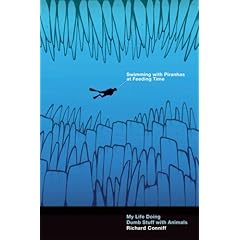
Book Review: Swimming with Piranhas at Feeding Time


As I noted last week, traveling is a perfect time for catching up on your reading. Long flights and layovers in spartan airports with little to do, makes you appreciate a good book all the more. And when heading to South America, I just had to take along a book I had received a few days before departing. I mean, it's called Swimming with Piranhas at Feeding Time by Richard Conniff. How could I possibly leave that behind when I was headed to the Amazon?

Much like Jon Bowermaster's new book, Wildebeest in a Rainstorm, which I reviewed last week, this book is a collection of articles that the author has written over a number of years. Conniff has extensive experiencing traveling the globe and writing about its creatures, both great and small.

The stories in the book range from trailing wild dogs on Botswana's Okavango Delta to the title adventure, in which Conniff decides to take a dip in a tank full of Piranhas at the Dallas aquarium. In between, you'll learn a lot about bugs, including the level of pain they inflict when they bit or sting, as well as far more than you'd ever wanted to know about their sex lives. There are stories about elusive leopards, cheetahs, humming birds, monkeys, and more.

The books is a fast read, as each of the chapters is a self contained story, and Conniff's writing style is not only interesting, but often humorous as well. I often found myself wrapping up one of the stories and plunging headlong into the next, just to see what new topic he would explore next. And while I was fascinated reading about his adventures tracking leopards in Namibia with the !Kung San, perhaps the greatest trackers in the world, I was equally enthralled with his report on Lemurs in Madagascar and his profile of Justin Schmidt, an entomologist who has devised a scale for measure the pain of an insect bit or sting. The scale ranges from one, described as "a tiny spark", to four, which is "absolutely debilitating".

Through it all, it's clear that Conniff loves what he does, and has enjoyed a long, and stored career covering amazing wildlife in every corner of the planet. He has a passion for all of these creatures, not just the big cats and intelligent primates, but the little creepy crawlies as well, and it shows through in his articles, which are fun to read, but also very informative as well. I learned a lot from each of these articles, sometimes to my dismay. For instance, in the chapter on Schmidt's pain scale, I learned that bullet ants, native to South America, get their name from the fact that when they bite you, it feels like you've been shot. As I lay in my bunk that night, aboard the river boat that was my home on the Amazon for my trip, I recalled how many of those ants I had seen that morning, while trekking in the jungle. I double checked my boots to make sure none came home with me.

Anyone who loves, or is even curious about, the animals and insects that we share this planet with will enjoy this book. It'll make you laugh, but it'll also make you marvel at the incredible diversity of life and its amazing resiliency. So many stories to be told, and Conniff is one of the best at telling them.

Thứ Sáu, 16 tháng 1, 2015

Semana Santa | Reuters' Full Focus

Photo © REUTERS/Marcelo del Pozo-All Rights Reserved
Try to say the following in one go...without pausing to take your breath.

"Holy Week is the week preceding Easter and the final week of Lent. Holy Week begins with Palm Sunday and ends with Holy Saturday, the day before Easter Sunday. Holy Week includes Holy Thursday (also known as Maundy Thursday) and Good Friday, which, together with Holy Saturday, are known as the Triduum. Before the revision of the liturgical calendar in 1969, Holy Week was the second week of Passiontide; in the current calendar, Passiontide is synonymous with Holy Week."

Out of breath and confused? That's okay.

Reuters Full Focus has two dozen photographs of the Holy Week, which are worth you stopping by. Most of the remaining photo bogs will sooner or later feature photographs of this week long event, but Reuters was the first.

I have a travel photography bucket list, and the Semana Santa event in Seville is certainly on it. This event is one of the important traditional events of the city, and is celebrated in the week leading up to Easter. The week features the procession of floats of lifelike wooden sculptures of individual scenes of the events of the Passion, or images of the Virgin Mary showing grief. Some of the sculptures are ancient, and are revered.

Photo © Tewfic El-Sawy-All Rights Reserved

I attended a Semana Santa in La Antigua (Guatemala), and it was quite an experience. Although small, it featured some rituals indigenous to this Central American nation, which included covering streets of La Antigua with natural, aromatic carpets of flowers, pines, clover and fruits, which the residents made and placed in front of their homes.

I'm interested in the Spanish observances during Holy Week, especially in the smaller towns and villages where one can see processions of hooded flagellants in chains and performing self mortifications...and this is on the bucket list.

Thứ Ba, 13 tháng 1, 2015

POV: Shooting Thru The Lens Cap

Photo © Shane Green-All Rights Reserved
I've posted this hilarious photograph on various social media, including my Facebook Timeline, with the hope it goes 'viral'...or something like that.

The simple and short backstory to the photograph is this:

During my recent The Sacred Cities Photo Expedition-Workshop to Varanasi and Vrindavan, our first stop during the Holi week was in Barsana, and Shane Green (one of our group members, and a great guy) pointed his camera at me, and I immediately reciprocated with my lens cap on. Some of us were covered with gulal, the colored powder used during the festival....but I had escaped unscathed with just a trace of it on my clothes.

I've learned through my years in international banking that humor, and the ability of poking fun at oneself, plays an important role in one's "branding" and in marketing services, products and whatever else one is offering...so this photograph is heaven sent, and I will use it in all possible ways to extend my reach in marketing my expeditions-workshops.

No vulgarity, obscenities or acting like a clownish juvenile...humorous and subtle self-deprecation goes a long way...a very long way .

Thứ Sáu, 9 tháng 1, 2015

Michael Švec | The Kingdom of Mustang

Photo © Michael Švec-All Rights Reserved
Mustang (derived from the Tibetan word Möntang) is the former Kingdom of Lo where Tibetic languages are still widely spoken and traditional Tibetan culture remains. It was once an independent kingdom, although closely tied by language and culture to Tibet. From the 15th century to the 17th century, its strategic location granted Mustang control over the trade between the Himalayas and India. At the end of the 18th century the kingdom was annexed by Nepal. Its monarchy ceased to exist on October 7, 2008, by order of the Nepalese government.

It's a weeklong hike from the nearest airport (usually Jomsom or Pokhara) to the capital city of Lo Manthang, which is is one of the best-preserved medieval cities in the world, and which was  recognized by UNESCO as a world heritage site.

The remoteness of Mustang hasn't discouraged Michael Švec from traveling to photograph its landscapes and people, and produce a wonderful audio-slideshow titled The Last Forbidden Tibetan Kingdom.

While Michael Švec is a digital art director in Prague, he is also a documentary and fine art travel photographer, who works on assignments in Asia, Middle East and Europe. He traveled the world for more than ten years, focusing his lens on documenting traditions of changing cultures around the world, human rights issues and spirituality within people and places.

He tells us that he likes to stay with the people of the regions he travels to, he lives with them, eats with them and shares their lives as much as they allow him to. He needs to be accepted by the community before taking the pictures. Nice sentiment, and a difficult to achieve sometimes.

Michael's portfolio includes an audio-slideshow of the Indian Kushti wrestling, as well as slideshows of the Kalash people of Chitral in northern Pakistan, of the Pushkar camel fair and of the tribes of the Kutch.

Delve a little deeper, and you'll find photographs of Rio de Janeiro, Rajasthan, Ethiopia, Nepal, Kashmir, Iran, Morocco and Kashmir amongst others.

Thứ Sáu, 2 tháng 1, 2015

Man Lost in Arctic Survives 3 Days Alone


The details are still bit sketchy on this one, but it is a cool story none the less. According to this story, on Yahoo News, an American man working in Greenland became lost, and survived for three days, in arctic conditions.

At the moment the man's name has not been revealed, but we do know that he is a heavy equipment operator at a research station in Greenland's Arctic region. He first went missing sometime in the evening last Wednesday, but the details on how he got lost are not quite explained. He was later found, alone, in good health, and completely coherent, on Saturday morning, following an extensive search and rescue operation.

The remote base, known as the Summit Station, at which the 38-year old is employed, is said to be located in central Greenland, atop more than two mile thick ice. The closest "point of land", according to the article, is some 260 miles away. It is also reported that the average temperature in the overnight hours this time of year ranges from -10ºF on clear nights to 10º when it is overcast.

The man is said to have used some basic survival techniques taught to everyone at the station. He reportedly dug holes in the snow to get out of the wind and would move around regularly to keep his blood pumping and circulating. He is being treated in Nuuk, Greenland's capital, and is expected to make a full recovery.

Anyone else sense a movie of the week from this story?

PlanetFear Brings Us The Most Extreme Races


Adventure website PlanetFear has a cool list of the World's Most Extreme Races, naming off some of the top endurance event on the planet, or as they call the list, "the thigh quivering guide to some of the world’s most outrageous races…"

The author of the article, Ben Winston, determined the "extremeness" of each race by giving them a label, such as "The Most Northerly" or "The Highest", and then follows up with a photo from the event, and a brief description of what you can expect to endure while competing.

For instance, they name the legendary Marathon des Sables as "The Hottest". The race takes place annually in the Sahara Desert of Morocco, with competitors racing 150 miles over six days in a stage event format. Average temperatures tend to hover around 120ºF.

But if the heat isn't that rough on you, perhaps you'd rather face the humidity. Yep, they have a winner in the "Most Humid" category, with the prize going to The Jungle Marathon, a seven day event that covers 120 miles across Brazil's dense jungles. Competitors have to carry everything with them, with the exception of their water, which is replenished each day, and hammock to crash in when they reach the nightly camps. And if that humid jungle wasn't enough of a challenge, they'll have to deal with poisonous snakes and insects, not to mention an array of fungal infections and disease.

Great list of top races from around the planet. Still no love for Primal Quest though. I'm starting to feel a bit disrespected. We seriously need to make PQ more challenging.

Thứ Năm, 1 tháng 1, 2015

POV: In Praise of The Foundry Photojournalism Workshop (Again)

Photo © Adriana Zehbrauskas
As this blog's followers and readers know, I attended the Foundry Photojournalism Workshop in La Antigua Guatemala just over two weeks ago. It was my sixth workshop as a faculty member; having missed Sarajevo out of the workshops held in Mexico City, Manali, Istanbul, Buenos Aires, Chiang Mai and now La Antigua,

Once again, while it is the students and instructors who are in the limelight during the workshop, it's the unsung heroes of the Foundry's staff,  its administrators and the local volunteers who consistently make them such wonderful successes. This particular workshop in La Antigua was particularly challenging in view of its venue (the conference rooms at the Casa Santo Domingo) being so dreadfully expensive to rent.

As always, Eric Beecroft, as the visionary force behind the Foundry Workshops, deserves singular praise. He had the  idea of creating such a workshop some 7 or 8 years ago, and made it a reality despite enormous obstacles. Eric, the staff and local volunteers worked around the clock, and deserve enormous credit for the success of yet again another wonderful Foundry.

I've often suggested to my class participants that attending a Foundry workshop is not only about enhancing their craft with advice of some of the best (and certainly selfless) photographers/photojournalists in the business, or about the class they've chosen or even about their own stories and image-making, but it's also about rubbing shoulders with other participants, whether these are peers, or just starting their photography careers, or veterans, and with all sorts of other styles of image-making....it's about augmenting their exposure to different worlds, about exposing themselves to divergent thought processes, to varying points of view, and in doing so...grow as human beings (and yes, as photographers too).

In my previous POV post, I refer to my personal photographic evolution...and there's little doubt in my mind that my involvement in the Foundry since 2008, meeting and viewing the work of my fellow instructors, as well as that of the students, has inspired a shift in my travel photography trajectory...and caused an evolutionary progress in my way of seeing...from the narrow focus on stock travel photography to a more documentary type of travel photography.

I'm quite certain of this, and I'm equally certain that many students, and possibly other instructors, have had their their own photographic evolution influenced by the osmotic phenomenon of the Foundry Photojournalism Workshops.

So when the next Foundry Photojournalism Workshop is announced (either Indonesia or East Africa...maybe), grab the opportunity and register.