Thứ Tư, 27 tháng 4, 2016

Shop till you drop, and feel good about it - VietNam Travel

It began with a modest fired teapot and that prompted a lacquered bamboo dish in a brilliant conceptual example, then a hand-woven scarf. It was simply the begin of my voyage through Vietnam, and I was at that point snared.


I am not generally a shopaholic, yet here not just did the costs speak to my Yorkshire sensibilities – nothing unless there are other options things cost more than £2 – however I could persuade myself that this retail treatment was doing some great. There's numerous types of tat on special to sightseers in Vietnam, much of it made in China. Anyhow I knew my using would have any kind of effect to neighborhood lives in light of the fact that I was on vacation with an association which makes that its mission.

Related post: Vietnam travel


Traidcraft, the individuals behind the British inventories and blessing shops, has collaborated with cycling-occasion administrator Saddle Skedaddle (one of its organizers used to work for Traidcraft) to offer treks to the creating nations the philanthropy sources its products from. The thought of Traidcraft's "Meet the People" occasions (there's no cycling on this specific excursion) was to give individuals who were at that point a piece of the reasonable exchange development – volunteering in shops, running stalls – the opportunity to see where items began.

Actually for those who've never been close to a reasonably exchanged soil grown foods bowl, the visits offer a special viewpoint, on individuals and societies and touring. (They likewise run outings in other Asian nations, and in Africa and Latin America.) Plus you get to shop till you drop, and like it.


My teapot and dish originated from a showroom in Hanoi run by Craft Link, a non-benefit association that works with 60 artisan aggregates in northern Vietnam. Over tea and little cakes upstairs, we got notification from administrator Ms Tran and more youthful Ms Thuy about its work discovering markets for crafted works as a method for keeping customs alive and assuaging neediness. It's not philanthropy: they help bunches for several years, with preparing and monetary backing. Also they generally work with ladies.

At that point we were let detached in the shop: our gathering of 15 Brits gobbled up silk satchels and scarves, sacks, ceramics and gems. There was still more than two weeks of the visit left, yet hey, a flawless little clasp won't consume up much space.

Following day, talking on the transport as we cleared out Hanoi for an outing heartland, Ms Thuy let me know she's proudest of the impact Craft Link has on the part of town ladies. Consider, she said, your normal Vietnamese agriculturist: he's been reveled from early stages (while his sisters buckled down) and graduates to the nearby diversions of wife-beating and drinking rice wine. Despite the fact that money salary is just about $100 a year, there's bounty to consume, from the chickens, fishpond, rice paddies and vegetable arrangement. At that point the wife finds out about these city individuals who'll pay great cash for her weaving. What's more quickly she's using her days sewing in a chipper gathering with her companions, as opposed to weeding the paddies and rubbing his feet. Furthermore he can't gripe, on the grounds that she accumulated almost $400 a year ago: its paid for a TV, and he's trusting for a motorbike.


Ms Thuy once asked a hilltribe lady what had changed since she began offering painstaking work. "Presently I can grin," she said, uncovering a column of pretty teeth. Her teeth had spoiled when she was in her 20s, however her art cash had paid for a set of crowns.

Our terminus was the Mai Chau valley – home to ethnic minority White Thai individuals – however we halted first at Ha Thai town, which represents considerable authority in lacquered bamboo. A family bunch in one workshop were finishing a US request for 3,000 bowls with an exquisite painted stripe – they get 30% of the last cost. We viewed the age-old methodology of part bamboo, bowing it, snaking it round a mold then sanding it before applying 15 layers of (nourishment safe) cashew-nut finish. Up the road, men and ladies were utilizing globules and coconut shells to make beautiful adornments – ooh, yes, my little girl will like that bangle, with its white-on-dark example.

Some in our gathering perceived these items from Traidcraft outlets back home and could discuss how well, say, a specific vase offers. That was what made this trek distinctive: we were in small towns vacationers would never regularly see, not as outsiders, yet as a feature of the exertion to bring flourishing to these groups. (All the more motivation to take home one of those really shaded trays, as well.)

The area of Mai Chau, 100km from Hanoi, is exemplary rustic Vietnam: rice paddies extending level as a green fitted rug to a ring of rugged mountains, with tapered caps and water bison spotting the fields. This is the place a considerable measure of Craft Link's materials are made. A companion's approaching birthday came up with a decent rationalization to get a delicate scarf in quieted green and red. One weaving machine on the edge of the town was being worked by an adolescent and ambitious incapacitated lady: as we passed she gave pursue in her wheelchair with a determination of her products

Thứ Sáu, 15 tháng 4, 2016

Jon Bowermaster is off to Madagascar


Speaking of Jon Bowermaster, when last we checked in with him, he was in the Maldives, investigating the impact of rising sea levels on that nation's future. He has since moved on to the Seychelles Islands, where he discovered that pirates have become a very real threat.

His journey across the Indian Ocean wasn't done there however, as he has proceed on to Madagascar, an already poor country that has been hit hard by the global economic recession, and is now struggling with a great deal of political unrest as well. Tourism has been a boon for the island nation for a number of years, and two recent animated films have actually helped that industry. But in this economic environment, many people are not traveling, and with the unrest in Madagascar leading to riots in recent month, those that are venturing abroad, have elected to avoid the country for the most part.

It seems Jon's tour of the region won't end here either, as judging from this map, he'll next be moving on to the Comoros Islands, a small island nation with a rich and diverse history. From there, it's on Mozambique before proceeding north to Tanzania. This trip makes my little foray into the Amazon seem like I was just dipping my toe in the water!

Be sure to check back with Jon's blog regularly. His updates are always insightful and interesting, and I almost always learn something new about the places he visits. They also almost always wish I was tagging along too!

Thứ Năm, 14 tháng 4, 2016

Himalaya Spring 2009 Update: Issues in the Icefall, Summit Push on Manaslu


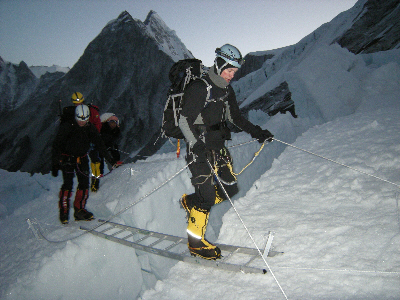
Time for a late week round up on what is happening in the Himalaya, where throughout the week we've been hearing that there are issues in the Khumbu Icefall near Everest. It was widely reported throughout the week that the route through the icefall, often called the most dangerous part of the mountain, had collapsed, preventing teams from making their way up to the high camps. The route was down for portions of three days in a row, but of course, it was repaired fairly quickly, Ice Doctors doing their usual bang-up job, and access was restored to the mountain once again. This is not an uncommon occurrence in the icefall, where the ice shifts constantly, and seracs collapse with regularity. It can obviously be quite dangerous, but the Docs are consummate professionals, and usually have things repaired ASAP.

For most of the teams, it was another acclimatization week on Everest, with many making their way up to C2 for the first time, where they generally spend the night, and sometimes all the next day as well. The process of getting your body use to that altitude is a slow one, so it is important to spend time there before returning once again to base camp. Alan Arnette conintues to update his Everest 2009 page with some great info of where everyone is at on the mountain, plus his own personal insights into what is going on.

ExWeb is also reporting that the Sherpas have fixed the lines as high as Camp 3, opening the door for the climbers to head on up to that point soon, and continue the acclimatization process. They are also reporting that the Kazakh team working the Lhotse-Everest Traverse, are already at 7300m as they make their alpine style go both summits.

The Himex Team has split into several groups, and are heading back to Lobuje Peak for another acclimatization climb according to Billi Bierling, who will be going for her second successful summit there. Of course, Russell Brice know what he is doing in get his clients ready for the big hill, but not all clients are treated the same, as David Tait, who has climbed with Brice in the past, will skip a second trip up Lobuje, and instead climb to C2 on Everest instead. David already has a successful North to South traverse to his name, and is quite experienced on the mountain.

Meanwhile, other teams are weighing in, with the Peak Freaks updating their blog to indicate that they have team members stretching from BC all the way up to C3 where the Sherpa are fixing ropes. IMG is in a similar position with climbers in BC, C1, and C2. They are also helping to coordinate with other teams on fixing the ropes, making sure everyone is contributing something to the cause. The Adventure Consultants are back in BC on the other hand, having already spent four nights on the mountain, including one night in both C1 and C3. The team is well ahead of the game when it comes to acclimatization and are feeling good at the moment.

On the North Side of Everest, things are still gearing up. The Summit Climb Team reached ABC this week, and there are several other teams strung out between base camp and advanced base camp, with an interim camp in between. ExWeb is also reporting that the Canadian team led by Manuel Pizarro have elected to go for a permit to climb from the Tibetan side of the mountain, rather than their planned South Col route. They are en route to North Base Camp, and hope to be there early next week.

Moving away from Everest and to some of the other peaks, it looks like it is go time on Manaslu, where teams are in the midst of a summit push at this very moment. There is reportedly a lot of snow on the mountain, and that is making things treacherous, but despite those conditions, teams hope to top out on Monday.

Meanwhile, over on Annapurna, the weather conditions are forcing teams to abandon the mountain altogether. There is a lot of snow on the upper slopes, and Annapurna is notoriously dangerous when it is prone to avalanches. Base camp is reportedly nearly empty already.

On Dhaulagiri, the Polish Tatra Rescuers Expedition has already made a run up to C3 and are currently back in base camp, resting, and waiting for a weather window to make a go at the summit. ExWeb also reports that sadly, Peter Hamor has returned to Kathmandu and is filling out reports on climbing partner and friend Piotr Morawski, who died on the mountain a few weeks back.

Finally, Ben Clark posts a dispatch on the Ski The Himalayas website with an update on their progress. He, along with friends Josh Butson and Jonathan Miller, have their hopes set on as summit, and ski descent of 23,390 foot Baruntse. The team is still two days away from BC, but it has already been quite an adventure, with plenty of rain and snow so far. Ben notes that yesterday alone they had to traverse three 14,000 foot passes, in whiteout conditions no less. The best part is that all of that hasn't dampened Ben's enthusiasm for the adventure at all, and just reading his words you can tell how excited he is to be back in the Himilaya. We should all be so lucky.

Thứ Bảy, 9 tháng 4, 2016

Christian Werner | Chained In Paradise


Mental sickness, lack of psychiatric hospitals and traditional healers...all come together in a compelling and disturbing documentary on the mentally sick who are chained, caged or tied up by their families,  on the "paradise" island of Bali.

As is common with other nations of the world, Indonesia is unable to provide adequate mental health facilities to those who are in dire need of them, and it's reported that there are 40,000 Indonesians who are afflicted with mental illnesses, and are treated inhumanly. In Bali alone, it's reported that there are 350 cases who are chained like animals...for fear they will wander off, or that they'll hurt someone or themselves. The Balinese call them "pasung"... or "in chains" and consider them to have been 'punished' by the gods..

With the lack of mental health facilities, families refer those mentally sick to traditional healers; the balians, as they're called, number about 8,000 in Bali. There are about four times as many balians as doctors. The balians are traditional healers who play an important part in Bali’s culture by treating physical and mental illness, removing spells and channeling information from the ancestors.

I photographed balians during one of my photo expeditions in Bali, and found them to be a mix of witch doctors and chiropractors, mixing mumbo-jumbo with massage and manipulation. Most of those I've seen had waiting rooms with many patients.

Chained in Paradise still photographs can be viewed on Christian Werner website.

Christian Werner is a freelance multimedia/photojournalist based in Nordstemmen, Germany. H graduated from the photojournalism & documentary photography course at the University of Applied Sciences in Hannover. His interests are social diversity and global political issues. He worked in various countries in Asia, Africa, Eastern Europe and South America, and he's represented by the agency Laif.

Thứ Bảy, 2 tháng 4, 2016

Ha Noi | Report 9 | The People of Tay Bac

Photo © Tewfic El-Sawy-All Rights Reserved
The group's morning assignment was ostensibly a simple one; during a single photo shoot, and in 15-20 photographs, show Hanoi's teeming life in its streets.

However, the assignment was to be in monochrome. Not as simple as initially thought, eh? Especially with Ha Noi's Old Quarter vivid colors and textures, and particularly galling because of the wondrous light that appeared after every thundershower.

The other objective of the assignment was to encourage the participants to see and capture  "layers"...the fundamental attribute to successful street photography...and to record ambient street noise/sound to accompany the photographs. It was up to them whether to shoot from the hip or otherwise.

I chose to feature the above photograph in monochrome and color...to provide a contrasting view of the same image, and leave it to the viewers as to which they prefer. Both have different aesthetic merits, and both are faithful in their depiction to what I saw. The photograph was made by shooting from the hip so as not to disturb the woman.

By the way, she is playing Candy Crush on her Apple iPad.