Trail Magazine, a U.K. publication, sent a team up Kilimanjaro and have posted part 1 of their video on the climb on their website at LiveForTheOutdoors.com. The video is very well done and does a great job of showing the first day or two on the mountain, along the Machame Route, the same one I took while on Kili.
As indicated in the video, the first day is actually tougher than you would think, and you spend much of it in a dense, humid cloud forest that doesn't break until you reach the first camp near the end of the day after about six hours of climbing very steep paths. Check out the video below and stay tuned for Part 2. Looks like it should be a fun series to follow.
Hiển thị các bài đăng có nhãn Kilimanjaro. Hiển thị tất cả bài đăng
Hiển thị các bài đăng có nhãn Kilimanjaro. Hiển thị tất cả bài đăng
Thứ Tư, 12 tháng 10, 2016

Thứ Hai, 19 tháng 9, 2016
Climbing The Seven Summits: What's it Cost?

There is a very good post over at Stewart's Climbing Blog that lays out the costs of climbing the Seven Summits. The article is a bit of an eye opener for those who would love to pursue this goal, but aren't sure what it all entails nor how much it would hit them in the pocket book.
Stewart breaks down the costs in a very logical manner and into several categories. He takes a look at the guide fees, gear costs, training fees, airfare, and more. And when he tabulates the final bill what does it come to? A whopping $170,250.
As you might imagine, Everest makes up the bulk of that cost, although both Vinson, in Antarctica, and Carstensz Pyramid, in Indonesia, are not cheap either. Stewart estimates roughly $65,000 for Everest alone, and while that is a safe estimate, it is also a bit on the high end of the scale. You can find expeditions to the highest mountain on Earth at cheaper rates with some very good companies. The same can be said for Vinson and Carstensz, although the options are not as plentiful.
And the cheapest of the mountains to climb? Kilimanjaro clocks in at $3150 (My climb was considerably cheaper than that) and Aconcagua is second at $3700.
All in all though, it's a decent estimate and does put some things in perspective. Certainly an interesting read for armchair mountaineers and climbing enthusiasts alike.
Thanks to Jason over at The Adventurist, who is back off his hiatus and updating regularly again as well.
Thứ Sáu, 26 tháng 12, 2014
The Dangers of Kilimanjaro
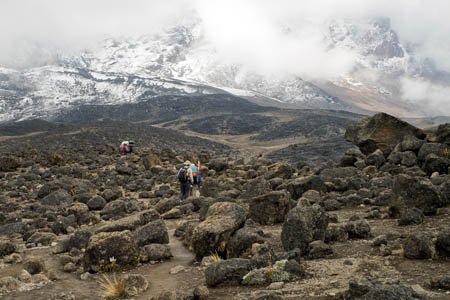
Grough has an interesting article up on the dangers of climbing Kilimanjaro, which are detailed thanks to a new study that calls it one of the most dangerous mountains in the world.
The study was conducted by British doctor Jeremy Windsor and American Dr George Rodway. Windsor, who is an advisor to the Union Internationale des Associations d’Alpinisme, is quoted as saying "Despite reliable weather and straightforward access, illness and injury are commonplace" on Kili. The report cites the fact that guide fees and services put an emphasis on getting up and down quickly, not allowing for many climbers to acclimatize properly.
While I obviously respect the mountain, and think that it is far more challenging than the average trekker realizes before they go, I have to disagree with the good doctors that it's one of the most dangerous mountains in the world. Sure, any time you're dealing with high altitudes there can be issues. Throw in the fact that you're in a remote place, with challenging terrain, and you've added a layer of complexity to the problem. But thousands of people go up and down Kilimanjaro each year, mostly without incident, and there are relatively few deaths on the mountain when you look at the amount of traffic there. It's non-technical nature also insulates it to some degree, although unprepared and inexperienced climbers probably are the biggest cause for concern.
To illustrate my point, the article goes on to talk about the dangers of making the climb, but references many issues that are not even a concern on the mountain. For instance, Windsor says that there are an alarming number of electrocutions with visitors to Tanzania due to substandard wiring in hotels. While obviously a concern, how is that related to Kili exactly? They go on to discuss HIV/AIDS, as well as other diseases, and even the risk of a fatal car accident, which is the number one killer of visitors to the country.
They do eventually talk more in detail about the actual issues on the mountain itself, touching on altitude sickness, and all the issues that can bring along with it. They also talk about exposure and the colder temperatures up near the summit, but that isn't nearly as much of a concern as it is on a lot of other mountains.
All in all, an interesting article, even if I don't necessarily agree with everything they are saying. Certainly it's a good read for those planning a trip to Africa to make the climb. My word of advice is respect the altitude, give yourself plenty of time, and enjoy the scenery along the way. Oh! And careful when plugging things into the electrical outlets apparently. ;)
Chủ Nhật, 15 tháng 12, 2013
Kilimanjaro Climbing Video - Part II
U.K. outdoor magazine Trail has released the second video of their recent climb on Mt. Kilimanjaro. I posted on their first video a few weeks back, and that video showed the prep for the climb and the first few days.
This new video, found below, begins on Day 3, and continues the journey with a hike up to the famous Lava Tower, before settling into Barranco Camp. Then it's up the daunting Barranco Wall, and the team starting to feel the effects of the altitude, before skipping ahead to Summit Day with some eventual shots at the Roof of Africa.
All in all, both videos are well done, and I recommend them for anyone considering Kili. The second video skips ahead fairly dramatically and glosses over a good portion of the trek, but I suspect that was for production reasons. Still, this is a good introduction as to what you can expect on the mountain, and a glimpse of what a week long climb is like there.
This new video, found below, begins on Day 3, and continues the journey with a hike up to the famous Lava Tower, before settling into Barranco Camp. Then it's up the daunting Barranco Wall, and the team starting to feel the effects of the altitude, before skipping ahead to Summit Day with some eventual shots at the Roof of Africa.
All in all, both videos are well done, and I recommend them for anyone considering Kili. The second video skips ahead fairly dramatically and glosses over a good portion of the trek, but I suspect that was for production reasons. Still, this is a good introduction as to what you can expect on the mountain, and a glimpse of what a week long climb is like there.
Đăng ký:
Bài đăng (Atom)