Thứ Tư, 28 tháng 1, 2015

It's Thaipusam Time...!

Photo © AP Phots/Joshua Paul - All Rights Reserved
A few days ago, the festival of Thaipusam was celebrated in various Hindu (mostly Tamil) communities in Asia, but its epicenter was in Kuala Lumpur, Malaysia as it has been for the past 125 years. It's a highly symbolic festival celebrated annually with a procession by devotees seeking blessings, fulfilling vows, offering thanks, celebrating Lord Subrahmanya or Lord Murugan, who represents virtue, youth and power to Hindus and is the destroyer of evil.

In Asia, more than a million Hindus thronged temples to celebrate this festival,  during which many display their devotion by piercing their bodies with hooks and skewers. On the day of the festival, devotees shave their heads and undertake a pilgrimage along a set route while engaging in various acts of devotion, notably carrying various types of heavy burdens, while others may carry out acts of self mortification by piercing the skin, tongue or cheeks with skewers and sharp hooks.

The devotees perform “Kavadi”, an act of faith where they suffer the pain of dozens of hooks and spears piercing their body during the 272 steps that bring them to the cave temple.

Yahoo News has featured a collection of photographs taken a various photographers (some photographs are rather gruesome) on its News webpage. These are arranged in a slideshow format.

It is said that there an incredible amount of photographers and photojournalists during the processions and at the Batu Caves; and it takes a lot of doing to avoid taking photographs with other photographers in them. I haven't noticed photographers in the slideshow...but I know full well the amount of effort (and frustration) it takes to do so.

Self mortification rituals are performed in a number of religious traditions; the Shi'a mataam on the day of Ashura is one of them. And I photographed the Kodungallur Bharani, a wild and unusual localized religious festival near Kochi, during which devotees symbolically strike their foreheads with swords till blood trickles down their faces.

Thứ Ba, 20 tháng 1, 2015

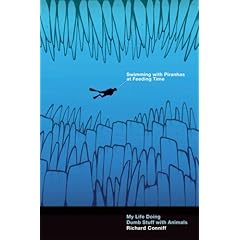
Book Review: Swimming with Piranhas at Feeding Time


As I noted last week, traveling is a perfect time for catching up on your reading. Long flights and layovers in spartan airports with little to do, makes you appreciate a good book all the more. And when heading to South America, I just had to take along a book I had received a few days before departing. I mean, it's called Swimming with Piranhas at Feeding Time by Richard Conniff. How could I possibly leave that behind when I was headed to the Amazon?

Much like Jon Bowermaster's new book, Wildebeest in a Rainstorm, which I reviewed last week, this book is a collection of articles that the author has written over a number of years. Conniff has extensive experiencing traveling the globe and writing about its creatures, both great and small.

The stories in the book range from trailing wild dogs on Botswana's Okavango Delta to the title adventure, in which Conniff decides to take a dip in a tank full of Piranhas at the Dallas aquarium. In between, you'll learn a lot about bugs, including the level of pain they inflict when they bit or sting, as well as far more than you'd ever wanted to know about their sex lives. There are stories about elusive leopards, cheetahs, humming birds, monkeys, and more.

The books is a fast read, as each of the chapters is a self contained story, and Conniff's writing style is not only interesting, but often humorous as well. I often found myself wrapping up one of the stories and plunging headlong into the next, just to see what new topic he would explore next. And while I was fascinated reading about his adventures tracking leopards in Namibia with the !Kung San, perhaps the greatest trackers in the world, I was equally enthralled with his report on Lemurs in Madagascar and his profile of Justin Schmidt, an entomologist who has devised a scale for measure the pain of an insect bit or sting. The scale ranges from one, described as "a tiny spark", to four, which is "absolutely debilitating".

Through it all, it's clear that Conniff loves what he does, and has enjoyed a long, and stored career covering amazing wildlife in every corner of the planet. He has a passion for all of these creatures, not just the big cats and intelligent primates, but the little creepy crawlies as well, and it shows through in his articles, which are fun to read, but also very informative as well. I learned a lot from each of these articles, sometimes to my dismay. For instance, in the chapter on Schmidt's pain scale, I learned that bullet ants, native to South America, get their name from the fact that when they bite you, it feels like you've been shot. As I lay in my bunk that night, aboard the river boat that was my home on the Amazon for my trip, I recalled how many of those ants I had seen that morning, while trekking in the jungle. I double checked my boots to make sure none came home with me.

Anyone who loves, or is even curious about, the animals and insects that we share this planet with will enjoy this book. It'll make you laugh, but it'll also make you marvel at the incredible diversity of life and its amazing resiliency. So many stories to be told, and Conniff is one of the best at telling them.

Thứ Sáu, 16 tháng 1, 2015

Semana Santa | Reuters' Full Focus

Photo © REUTERS/Marcelo del Pozo-All Rights Reserved
Try to say the following in one go...without pausing to take your breath.

"Holy Week is the week preceding Easter and the final week of Lent. Holy Week begins with Palm Sunday and ends with Holy Saturday, the day before Easter Sunday. Holy Week includes Holy Thursday (also known as Maundy Thursday) and Good Friday, which, together with Holy Saturday, are known as the Triduum. Before the revision of the liturgical calendar in 1969, Holy Week was the second week of Passiontide; in the current calendar, Passiontide is synonymous with Holy Week."

Out of breath and confused? That's okay.

Reuters Full Focus has two dozen photographs of the Holy Week, which are worth you stopping by. Most of the remaining photo bogs will sooner or later feature photographs of this week long event, but Reuters was the first.

I have a travel photography bucket list, and the Semana Santa event in Seville is certainly on it. This event is one of the important traditional events of the city, and is celebrated in the week leading up to Easter. The week features the procession of floats of lifelike wooden sculptures of individual scenes of the events of the Passion, or images of the Virgin Mary showing grief. Some of the sculptures are ancient, and are revered.

Photo © Tewfic El-Sawy-All Rights Reserved

I attended a Semana Santa in La Antigua (Guatemala), and it was quite an experience. Although small, it featured some rituals indigenous to this Central American nation, which included covering streets of La Antigua with natural, aromatic carpets of flowers, pines, clover and fruits, which the residents made and placed in front of their homes.

I'm interested in the Spanish observances during Holy Week, especially in the smaller towns and villages where one can see processions of hooded flagellants in chains and performing self mortifications...and this is on the bucket list.

Thứ Ba, 13 tháng 1, 2015

POV: Shooting Thru The Lens Cap

Photo © Shane Green-All Rights Reserved
I've posted this hilarious photograph on various social media, including my Facebook Timeline, with the hope it goes 'viral'...or something like that.

The simple and short backstory to the photograph is this:

During my recent The Sacred Cities Photo Expedition-Workshop to Varanasi and Vrindavan, our first stop during the Holi week was in Barsana, and Shane Green (one of our group members, and a great guy) pointed his camera at me, and I immediately reciprocated with my lens cap on. Some of us were covered with gulal, the colored powder used during the festival....but I had escaped unscathed with just a trace of it on my clothes.

I've learned through my years in international banking that humor, and the ability of poking fun at oneself, plays an important role in one's "branding" and in marketing services, products and whatever else one is offering...so this photograph is heaven sent, and I will use it in all possible ways to extend my reach in marketing my expeditions-workshops.

No vulgarity, obscenities or acting like a clownish juvenile...humorous and subtle self-deprecation goes a long way...a very long way .

Thứ Sáu, 9 tháng 1, 2015

Michael Švec | The Kingdom of Mustang

Photo © Michael Švec-All Rights Reserved
Mustang (derived from the Tibetan word Möntang) is the former Kingdom of Lo where Tibetic languages are still widely spoken and traditional Tibetan culture remains. It was once an independent kingdom, although closely tied by language and culture to Tibet. From the 15th century to the 17th century, its strategic location granted Mustang control over the trade between the Himalayas and India. At the end of the 18th century the kingdom was annexed by Nepal. Its monarchy ceased to exist on October 7, 2008, by order of the Nepalese government.

It's a weeklong hike from the nearest airport (usually Jomsom or Pokhara) to the capital city of Lo Manthang, which is is one of the best-preserved medieval cities in the world, and which was  recognized by UNESCO as a world heritage site.

The remoteness of Mustang hasn't discouraged Michael Švec from traveling to photograph its landscapes and people, and produce a wonderful audio-slideshow titled The Last Forbidden Tibetan Kingdom.

While Michael Švec is a digital art director in Prague, he is also a documentary and fine art travel photographer, who works on assignments in Asia, Middle East and Europe. He traveled the world for more than ten years, focusing his lens on documenting traditions of changing cultures around the world, human rights issues and spirituality within people and places.

He tells us that he likes to stay with the people of the regions he travels to, he lives with them, eats with them and shares their lives as much as they allow him to. He needs to be accepted by the community before taking the pictures. Nice sentiment, and a difficult to achieve sometimes.

Michael's portfolio includes an audio-slideshow of the Indian Kushti wrestling, as well as slideshows of the Kalash people of Chitral in northern Pakistan, of the Pushkar camel fair and of the tribes of the Kutch.

Delve a little deeper, and you'll find photographs of Rio de Janeiro, Rajasthan, Ethiopia, Nepal, Kashmir, Iran, Morocco and Kashmir amongst others.

Thứ Sáu, 2 tháng 1, 2015

Man Lost in Arctic Survives 3 Days Alone


The details are still bit sketchy on this one, but it is a cool story none the less. According to this story, on Yahoo News, an American man working in Greenland became lost, and survived for three days, in arctic conditions.

At the moment the man's name has not been revealed, but we do know that he is a heavy equipment operator at a research station in Greenland's Arctic region. He first went missing sometime in the evening last Wednesday, but the details on how he got lost are not quite explained. He was later found, alone, in good health, and completely coherent, on Saturday morning, following an extensive search and rescue operation.

The remote base, known as the Summit Station, at which the 38-year old is employed, is said to be located in central Greenland, atop more than two mile thick ice. The closest "point of land", according to the article, is some 260 miles away. It is also reported that the average temperature in the overnight hours this time of year ranges from -10ºF on clear nights to 10º when it is overcast.

The man is said to have used some basic survival techniques taught to everyone at the station. He reportedly dug holes in the snow to get out of the wind and would move around regularly to keep his blood pumping and circulating. He is being treated in Nuuk, Greenland's capital, and is expected to make a full recovery.

Anyone else sense a movie of the week from this story?

PlanetFear Brings Us The Most Extreme Races


Adventure website PlanetFear has a cool list of the World's Most Extreme Races, naming off some of the top endurance event on the planet, or as they call the list, "the thigh quivering guide to some of the world’s most outrageous races…"

The author of the article, Ben Winston, determined the "extremeness" of each race by giving them a label, such as "The Most Northerly" or "The Highest", and then follows up with a photo from the event, and a brief description of what you can expect to endure while competing.

For instance, they name the legendary Marathon des Sables as "The Hottest". The race takes place annually in the Sahara Desert of Morocco, with competitors racing 150 miles over six days in a stage event format. Average temperatures tend to hover around 120ºF.

But if the heat isn't that rough on you, perhaps you'd rather face the humidity. Yep, they have a winner in the "Most Humid" category, with the prize going to The Jungle Marathon, a seven day event that covers 120 miles across Brazil's dense jungles. Competitors have to carry everything with them, with the exception of their water, which is replenished each day, and hammock to crash in when they reach the nightly camps. And if that humid jungle wasn't enough of a challenge, they'll have to deal with poisonous snakes and insects, not to mention an array of fungal infections and disease.

Great list of top races from around the planet. Still no love for Primal Quest though. I'm starting to feel a bit disrespected. We seriously need to make PQ more challenging.

Thứ Năm, 1 tháng 1, 2015

POV: In Praise of The Foundry Photojournalism Workshop (Again)

Photo © Adriana Zehbrauskas
As this blog's followers and readers know, I attended the Foundry Photojournalism Workshop in La Antigua Guatemala just over two weeks ago. It was my sixth workshop as a faculty member; having missed Sarajevo out of the workshops held in Mexico City, Manali, Istanbul, Buenos Aires, Chiang Mai and now La Antigua,

Once again, while it is the students and instructors who are in the limelight during the workshop, it's the unsung heroes of the Foundry's staff,  its administrators and the local volunteers who consistently make them such wonderful successes. This particular workshop in La Antigua was particularly challenging in view of its venue (the conference rooms at the Casa Santo Domingo) being so dreadfully expensive to rent.

As always, Eric Beecroft, as the visionary force behind the Foundry Workshops, deserves singular praise. He had the  idea of creating such a workshop some 7 or 8 years ago, and made it a reality despite enormous obstacles. Eric, the staff and local volunteers worked around the clock, and deserve enormous credit for the success of yet again another wonderful Foundry.

I've often suggested to my class participants that attending a Foundry workshop is not only about enhancing their craft with advice of some of the best (and certainly selfless) photographers/photojournalists in the business, or about the class they've chosen or even about their own stories and image-making, but it's also about rubbing shoulders with other participants, whether these are peers, or just starting their photography careers, or veterans, and with all sorts of other styles of image-making....it's about augmenting their exposure to different worlds, about exposing themselves to divergent thought processes, to varying points of view, and in doing so...grow as human beings (and yes, as photographers too).

In my previous POV post, I refer to my personal photographic evolution...and there's little doubt in my mind that my involvement in the Foundry since 2008, meeting and viewing the work of my fellow instructors, as well as that of the students, has inspired a shift in my travel photography trajectory...and caused an evolutionary progress in my way of seeing...from the narrow focus on stock travel photography to a more documentary type of travel photography.

I'm quite certain of this, and I'm equally certain that many students, and possibly other instructors, have had their their own photographic evolution influenced by the osmotic phenomenon of the Foundry Photojournalism Workshops.

So when the next Foundry Photojournalism Workshop is announced (either Indonesia or East Africa...maybe), grab the opportunity and register.


Day Trip to Venice

I tried really hard for placing an appropriate adjective along with the title of the post. Only to conclude that it would be an understatement for the magic that Venice holds. Every corner and every moment in Venice is like a picture postcard. It's one of those places that you just so wish was real. It is. There are no vehicles, no roads. Exquisite pontes(bridges) connect one island on the lagoon with the other. One has to either take a water bus(Vaporetti) or water taxi or the best of all, be yourself on your feet. The remarkable thing about Venice is, that despite all the visitors and tourists, it still is successful in preserving its charm.
Venice
Venice through Vaporetti
Done with an early breakfast , we left for our journey from Florence to reach Venice in TrenItalia pre-noon. The journey was comfortable and quite relaxed. Both of us caught some sleep on board, which was later followed by some cups of coffee from the train pantry. Yet again, as always in Italy, we cut across through some of the breathtaking landscapes. The train journey was comfortable and most of the people who traveled were not tourists. Perhaps it had more to do with the timing of our train, than anything else. 

There is a tourist center that is located at a convenient location on the station Venezia Saint Lucia. There was a ritual exchange of maps, ideas on the division of time, and how to reach our hotel. We step outside the station to soak in simply amazing beauty of Venice. Every sight, every nook of Venice would for sure, stay with you forever

The sunshine floated through the waves of the lagoon, and in our Vaporetti we could simply not believe the breathtaking views that passed by. We lazed our way to reach our Hotel as we were carrying lot of luggage. Few bridges aside, we reached our hotel through bustling tourist streets.
Venice
Ponte showcasing the upcoming Venice festival
We caught up with our lunch and then took a ride of the magic of Venice in the water bus and saw the sun setting somewhere in Venice.

That was the best evening of my Life.

(Travel across Venice through night on the post 'Venice, Through the Night'.)

Shop What
  • Souvenirs
  • Glass based artifacts
  • Personae
Bottom Line
  • Gondola rides are highly overrated. These rides are simply not worth the price you pay.
  • Sometimes it may be difficult to find places. As a thumb rule, begin with some idea of your destination in Venice from the tourist center.
  • Free Maps were not available at the Tourist Center but you could find them at your Hotel.
  • Venice is expensive.
  • Public transportation is best on the Vaporetti, especially on Single day or 3 day passes. Highly recommended.
  • Hotel, at times can be far off from the Vaporetti stops which necessarily have to be covered on feet. Travel light or stay in hotels that are close to Vaporetti stops.
  • Venice is more European than other Italian cities with majority of people speaking English.
  • Best time to visit is during fall or winters.
Travel Facts
  • Stayed : 1 day .
  • Stayed at : Hotel , Scandinavia - OK, Choose better 'value for money' hotels close to Vaporetti stops.
  • Traveled with my better half .
  • Traveled in TrenItallia from Florence in January 2013.